


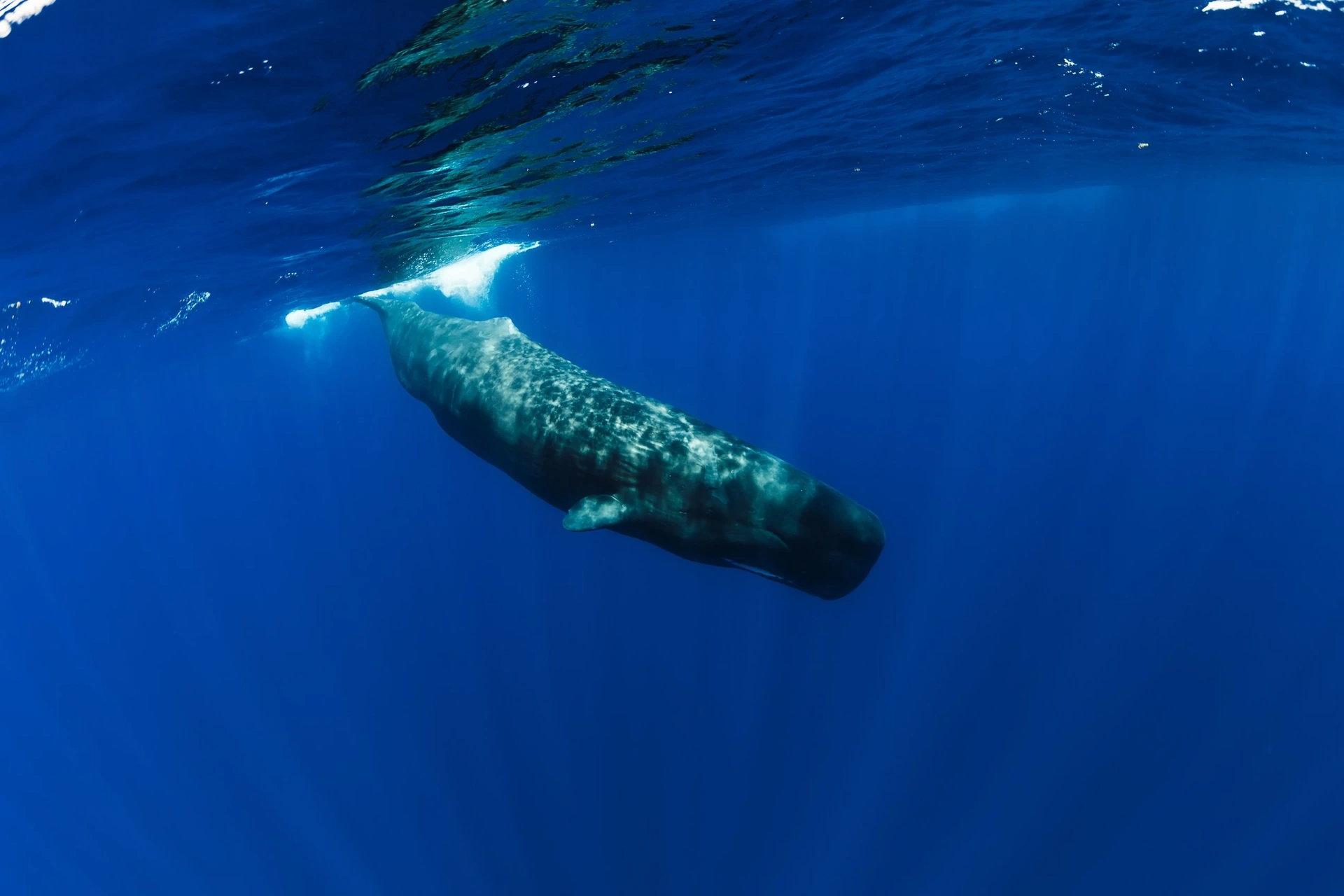
Sperm whale in Tenerife
Physeter macrocephalus · Cachalote · Pottwal
Species fact file
The sperm whale, a deep-sea giant living off the Canary Islands
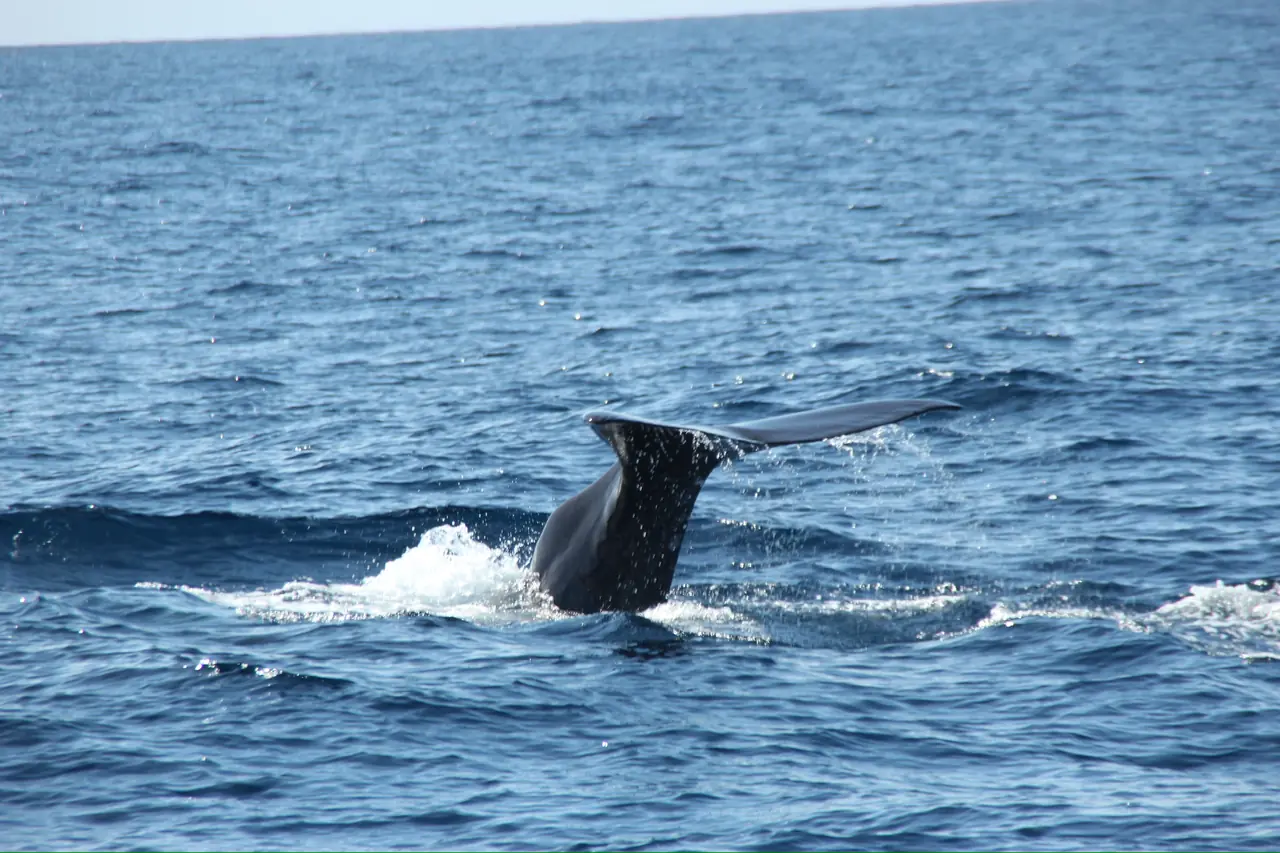
A sperm whale encounter is unlike any other. First comes the blow, angled forward. Then a dark, wrinkled back lies almost motionless on the surface, until the tail lifts clear of the water and the whale is gone for the best part of an hour.
Physeter macrocephalus is the largest toothed predator alive and one of the most remarkable animals in Canary waters. It finds everything it needs here, very deep water a short distance from shore and plenty of squid. That is why sperm whales turn up off south Tenerife, although not on every trip. They share these waters with the short-finned pilot whale and the rest of the marine wildlife around Tenerife, yet few sightings get people on deck as quickly.
Where sperm whales live, and why Tenerife suits them
Tenerife is a volcanic island that drops away steeply into the Atlantic. Off its southwest coast, only a few miles from Costa Adeje, the seabed already lies more than 1,000 metres down, right in the range where sperm whales hunt. Warm, deep water sheltered from the trade winds makes south Tenerife one of the best places in Europe to see them.
The sperm whales seen off Tenerife, as elsewhere in the Canary Islands, mostly travel in family units of females, juveniles and calves, which favour warmer seas. Adult males lead far more solitary lives, roaming huge distances before heading back to warmer latitudes to breed. The channel between Tenerife and La Gomera, a short sail from Puerto Colón, is one of the areas where they are found most regularly.

Sperm whale size, and how to recognise one
There is nothing else quite like it. The huge, box-shaped head takes up as much as a third of the body and holds the spermaceti organ, a large reservoir of oil involved in producing sound. The skin is dark grey or brownish with a deeply wrinkled look, and instead of a proper dorsal fin there is a low hump followed by a row of small knuckles towards the tail.
So how big are sperm whales? Adult males reach 16 metres and 45 tonnes, while females are much smaller at around 11 metres. From the boat there is one giveaway even at a distance. The blow shoots forward and to the left, because the single blowhole sits off-centre on that side of the head.

Life between the surface and the deep
Sperm whales are among the greatest divers on Earth. They regularly go below 1,000 metres and can stay down for close to an hour. Before each dive the back arches and the whole fluke rises out of the water, the shot everyone on board is waiting for.
Between dives they rest at the surface for several minutes, breathing slowly, and that is when you get the best look. On a whale and dolphin watching trip from Costa Adeje aboard a sailing boat, quiet and keeping the distance the regulations require, those few calm minutes beside a 15-metre animal feel very different from anything you see on a crowded motor boat.

What sperm whales eat, from squid to the giant squid
Their diet is built on deep-sea squid, hunted in complete darkness by echolocation. They send out trains of extremely powerful clicks, some of the loudest sounds made by any animal, and listen for the echo to pinpoint prey hundreds of metres below the surface.
The battle between the sperm whale and the giant squid has fed sailors' stories for centuries, and it is rooted in fact. Many sperm whales carry round sucker scars on their skin, and giant squid remains have been found in their stomachs. Most of what they eat, though, is far smaller squid, caught by the hundred on every dive.

Sperm whale vs. blue whale
Both are whales, but from two very different branches of the family. The sperm whale has teeth, like dolphins and pilot whales. The blue whale is a baleen whale that filters its food from the water. Seen side by side, they could hardly be less alike.
| Feature | Sperm whale | Blue whale |
|---|---|---|
| Group | Toothed whale, teeth in the lower jaw | Baleen whale, baleen plates instead of teeth |
| Size | Up to 16 m in males | Up to 30 m, the largest animal ever known |
| Diet | Hunts squid at great depth | Filters krill in shallower water |
| Blow | Angled forward and to the left | Tall, vertical column |
| Dives | Beyond 1,000 m for close to an hour | Much shorter and shallower |
Conservation and threats
The sperm whale is listed as Vulnerable by the IUCN. Commercial whaling cut populations dramatically through the 19th and 20th centuries. Today the main pressures are collisions with fast vessels, plastic ingestion and underwater noise, which interferes with how they hunt and communicate.
Whale watching in the Canary Islands is regulated by regional law. On board the Big Smile we follow the Barco Azul protocol on every departure, and we take extra care with sperm whales, because the time they spend at the surface is exactly what they need to recover oxygen before the next dive.
Sperm whale facts
- It has the largest brain of any animal, weighing around 8 kg.
- White sperm whales are real. Albino and very pale individuals have been recorded, and one of them, known as Mocha Dick, inspired Herman Melville's Moby Dick.
- Its echolocation clicks rank among the loudest sounds produced by any animal.
- It sleeps vertically, hanging still just below the surface for short periods.
- The pygmy sperm whale is a separate, much smaller species of around 3.5 m, only distantly related.
Sperm whale questions
How big is a sperm whale?
Adult males can reach 16 metres and 45 tonnes. Females are around 11 metres and 15 tonnes. Even a newborn calf is roughly 4 metres long.
Do white sperm whales really exist?
Yes, though they are extremely rare. Albino and very pale sperm whales have been documented. The most famous, Mocha Dick, was the real whale behind the novel Moby Dick.
Where can you see sperm whales in Tenerife?
In the deep water around the island, especially the channel between Tenerife and La Gomera. Where they appear depends on where they are feeding that day, so no trip can promise one, but when they do show up it is an encounter people never forget.
Can you see sperm whales on a trip from Costa Adeje?
Yes, though not on every trip. Sperm whales live in deep water and cover a lot of ground, so each sighting feels like a gift. What every Big Smile departure does guarantee is a cetacean sighting, with short-finned pilot whales and bottlenose dolphins as the regulars. If you would rather have the boat to yourselves, a private sailing trip to see whales and dolphins lets you set the pace with your own group. Departures from Puerto Colón, groups of up to 10 people and premium catering included.
