


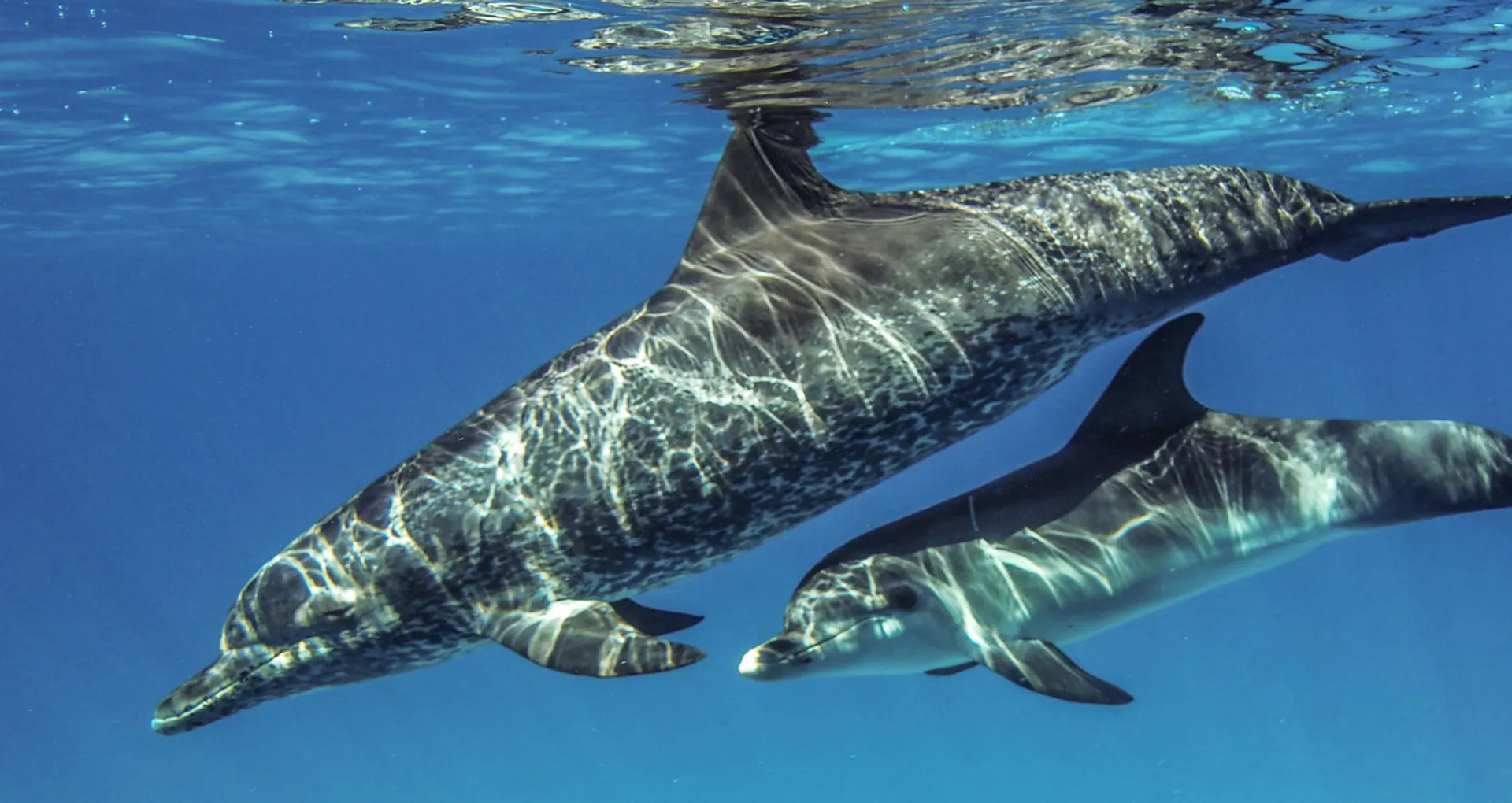
Atlantic spotted dolphin in Tenerife
Stenella frontalis · Delfín moteado · Atlantischer Fleckendelfin

Species fact file
The Atlantic spotted dolphin, the most playful dolphin off Tenerife
You know straight away when they turn up. They arrive as a group, fast, slicing through the water on both sides of the boat, and within seconds a few of them have moved in front of the bow to ride the wave the hull pushes ahead. Few species bring that kind of energy on board.
Stenella frontalis lives only in the Atlantic Ocean, in warm temperate and tropical waters, and the Canary Islands sit well within its range. Off south Tenerife it shares the water with the bottlenose dolphin, the striped dolphin and the short-finned pilot whale, although it comes and goes with the seasons, unlike the bottlenose dolphins and pilot whales that stay here all year. Of all the marine wildlife around Tenerife, it is one of the species guests are most excited to meet, because once it comes close it is impossible to miss.
Spotted dolphins riding the bow of our sailing boat
We shot these clips ourselves on our trips out of Puerto Colón. They are short, unfiltered and exactly what you see from the deck, with spotted dolphins swimming right under the bow.
Bow riding is what they are best known for. They use the pressure wave in front of the hull to move along with almost no effort, take turns at the front and come up to breathe a few metres from the people watching on the foredeck. A sailing boat moving slowly and quietly is the perfect setting for them to stay a while. They decide when to come in and when to leave, and we hold our course and speed so as not to disturb them.
What an Atlantic spotted dolphin looks like, and how to tell one from the boat
It is a medium-sized dolphin, 1.7 to 2.3 metres long, slimmer than a bottlenose and with a longer, finer beak. Adults often have a pale tip to the beak and a tall dorsal fin that curves back. The back is dark grey and the flanks lighter, scattered with spots.
The spots are the giveaway, and also the catch. Calves are born with no spots at all and pick them up as they grow, so the same pod can include young animals that look almost plain next to adults covered from head to tail. That is why they are sometimes mistaken for bottlenose dolphins. If you see a small, fast, streamlined dolphin travelling with others that are covered in dots, you are almost certainly looking at spotted dolphins.

When and where to see spotted dolphins in Tenerife
Unlike the short-finned pilot whales and bottlenose dolphins that live off the southwest of the island all year round, the Atlantic spotted dolphin is much more seasonal. It is seen mainly in the warmer months, roughly from late spring to early autumn. Outside that window, encounters are more hit and miss.
They tend to travel several miles offshore, in the open water off Costa Adeje and out towards La Gomera, often with shearwaters and other seabirds overhead, feeding on the shoals the dolphins drive up to the surface. No trip can promise them, but in season it is common to come across them on a whale and dolphin watching trip from Costa Adeje.
 Photo Alex Brown / iNaturalist · CC BY
Leaps, speed and hunting as a team
Spotted dolphins are highly social. They travel in pods of several dozen that can join up into much larger groups, and it is common to see mothers with calves tucked in tight against their side. They leap a lot, sometimes to travel faster and sometimes as part of play or a hunt, and they keep up a constant stream of whistles and clicks.
They feed on small fish and squid, mostly in the upper layers of the water. When they hunt together they herd shoals and push them upwards, and from the boat you can usually tell by the commotion of seabirds over the water. Now and then they mix with bottlenose dolphins, a sight you will not see every day and one that stays with you.

Spotted, bottlenose or striped dolphin, how to tell them apart
These are the three dolphins most often seen off south Tenerife, and from a distance they can look alike. Size, colour and the way they move will tell you which one you are watching.
| Feature | Spotted dolphin | Bottlenose dolphin | Striped dolphin |
|---|---|---|---|
| Size | 1.7 to 2.3 m, slender | 2.5 to 3.5 m, sturdy | 1.8 to 2.5 m, streamlined |
| Colouring | Light and dark spots that increase with age | Plain grey, no spots | Dark stripe from eye to tail, bluish and white flanks |
| Beak | Long and slim, pale tip in adults | Short and thick, bottle-shaped | Long and slim, dark |
| Behaviour | Acrobatic, often rides the bow wave | Curious and calm, approaches the boat | Very fast and leaps a lot, more elusive |
| In Tenerife | Seasonal, mostly in the warmer months | All year in the southwest | Occasional, in open water |
Spotted dolphin
1.7 to 2.3 m. Slender, with spots that increase with age and a pale beak tip. Very acrobatic and rides the bow wave. Seasonal in Tenerife.
Bottlenose dolphin
2.5 to 3.5 m. Sturdy, plain grey with a short beak. Curious and calm. Seen all year off the southwest of the island.
Striped dolphin
1.8 to 2.5 m. Dark stripe from eye to tail and bluish flanks. Very fast and more elusive. Occasional, in open water.
Conservation and protection
In Spain the Atlantic spotted dolphin is on the national list of wild species under special protection, and the Canary Islands catalogue of protected species gives it special protection around every island as well. The main threats it faces are accidental capture in fishing gear, pollution and shipping traffic.
Whale and dolphin watching is regulated in Spain and in the Canary Islands, and swimming with, touching or feeding the animals is not allowed. On board the Big Smile we follow the Barco Azul protocol on every departure. With a pod of spotted dolphins on the bow, the right thing to do is keep a steady course and speed and let them set the distance.
Spotted dolphin facts
- It is found only in the Atlantic. There are none in the Pacific or the Indian Ocean.
- Calves are born without a single spot. The spots appear over the years and keep multiplying.
- Every adult has its own spot pattern, and researchers use it to recognise individual dolphins.
- It should not be confused with the pantropical spotted dolphin, a separate species found in tropical waters around the world.
- It often hunts alongside seabirds, which pick off the fish the dolphins drive to the surface.
Atlantic spotted dolphin in Tenerife, your questions
Can you see Atlantic spotted dolphins in Tenerife?
Yes. Atlantic spotted dolphins visit the waters off south Tenerife, mainly in the warmer months. They are not year-round residents like the bottlenose dolphin or the short-finned pilot whale, so no trip can guarantee them, but in season they are regularly seen off Costa Adeje.
When is the best time to see spotted dolphins in Tenerife?
The warmer months, roughly from late spring to early autumn, are when they are seen most often. In winter sightings are more sporadic, although the resident species are still around.
How big is an Atlantic spotted dolphin?
Adults measure between 1.7 and 2.3 metres and can weigh around 140 kilos. They are noticeably smaller and slimmer than bottlenose dolphins.
Why do some spotted dolphins have no spots?
Because they are born plain and the spots come with age. Calves and juveniles have few or none, while older adults can be almost completely covered.
Can you swim with dolphins in Tenerife?
No. The Spanish rules on whale and dolphin watching, which also apply in the Canary Islands, do not allow swimming with them, touching them or feeding them. The responsible way to enjoy them is from a licensed boat that respects their distance and behaviour.
Want to see spotted dolphins from a sailing boat in Costa Adeje?
Every Big Smile departure guarantees a cetacean sighting, with short-finned pilot whales and bottlenose dolphins as the regulars. In season, spotted dolphins often join in, and they are usually the ones that spend longest at the bow. If you would rather have the boat to yourselves, a private sailing trip to see whales and dolphins lets you set the pace with your own group. Departures from Puerto Colón, groups of up to 10 people and premium catering included.
